🚶 Falls
Falls from height or hard surfaces can cause wrist, hip, ankle, spine, or arm fractures.
Fracture treatment in Pune
Prompt orthopedic assessment, stabilization guidance, and recovery-focused planning for fractures and injury-related bone pain.
⚕️ Urgent bone care
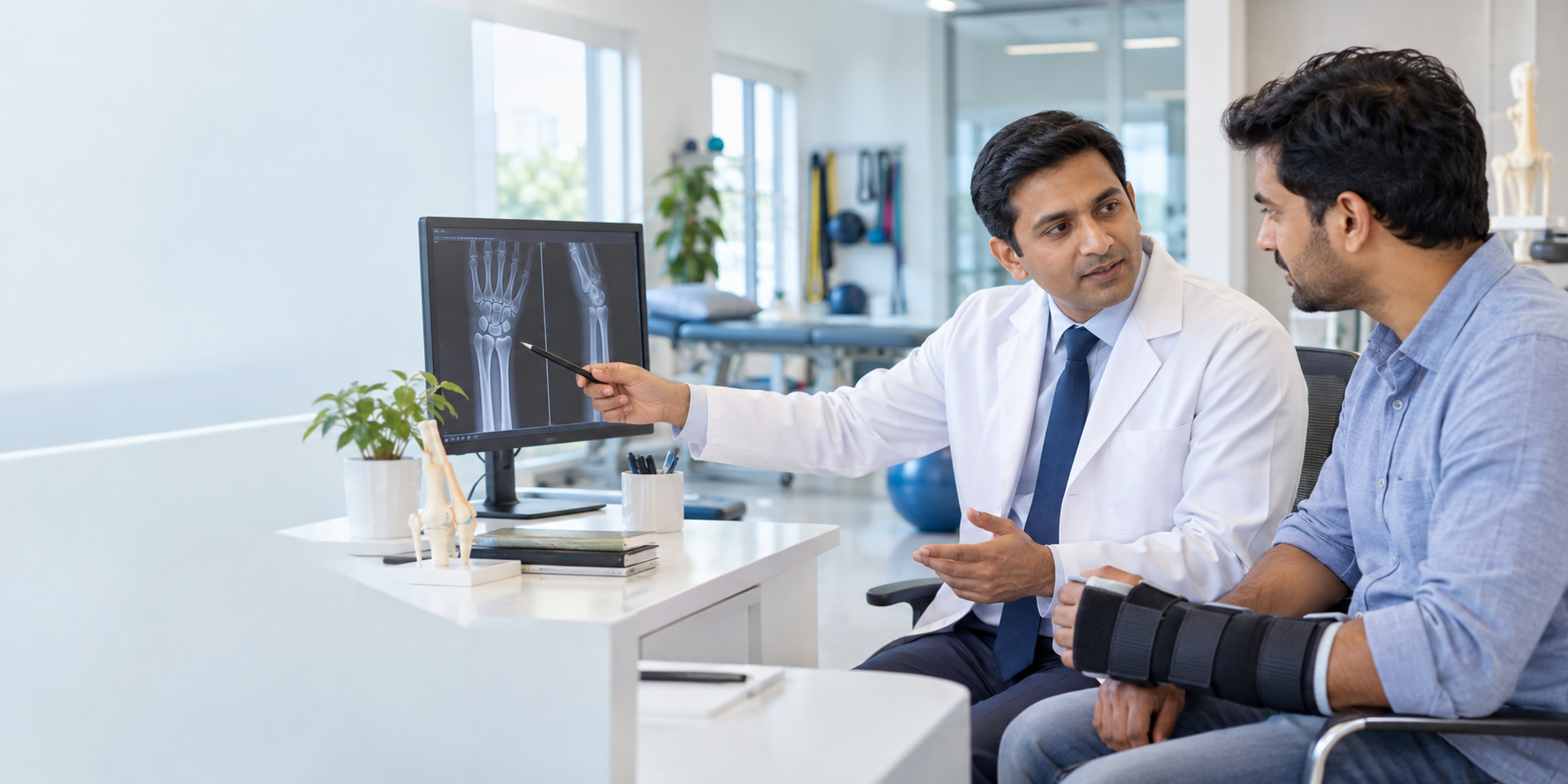
Fractures can result from falls, road traffic accidents, sports injuries, twisting trauma, or weakened bone structure. Early orthopedic assessment matters because it determines fracture type, joint involvement, displacement, and the treatment pathway that follows — decisions that are far harder to correct later than to get right at the first visit.
At our clinic in Pimple Saudagar, patients from across Pune and PCMC are guided through pain control, imaging-based evaluation, immobilization planning, and follow-up recovery support to protect alignment and restore function.
📋 What's actually true
| The Myth | The Reality |
|---|---|
| "If I can move it, it's not broken." | Some fractures, especially hairline or stress fractures, allow partial movement despite being a genuine broken bone — an X-ray is the only reliable way to confirm. |
| "All fractures need a cast for 6 weeks." | Healing time and immobilization method vary significantly by bone, fracture type, and severity — some heal faster, others need longer or different stabilization entirely. |
| "A fracture always needs surgery." | Many fractures are treated successfully with casting, splinting, or bracing alone, without any surgical intervention. |
| "Once the cast is off, you're fully recovered." | Removing a cast marks bone healing, not full functional recovery — physiotherapy is often what restores strength and confidence in the limb. |
🎯 Common causes
Falls from height or hard surfaces can cause wrist, hip, ankle, spine, or arm fractures.
Direct trauma may involve complex fractures, joint injuries, or urgent stabilization needs.
Twisting injuries and impact during sport can lead to fractures and ligament involvement.
Crush or impact injuries need careful assessment to protect bone alignment and circulation.
Osteoporosis-related fractures are especially common in older adults.
Fractures involving joints need precise planning to preserve long-term movement.
Emergency signs
Seek immediate emergency care for visible bone deformity, an open wound with bone exposure, inability to move the limb, or signs of poor circulation such as numbness, coldness, or a bluish colour beyond the injury.
Need Urgent Fracture Evaluation?🎯 Treatment goals
| Focus Area | What It Covers |
|---|---|
| 💊 Pain & Swelling Control | Immediate care helps reduce pain, protect the injured region, and limit further damage |
| 📍 Alignment Protection | Treatment aims to maintain proper bone position and support effective healing |
| 🔗 Joint Function Support | Early planning is important when the fracture is close to or inside a joint |
| 🛡️ Safe Healing | Structured follow-up helps track healing and reduce complications |
| 🚶 Mobility Recovery | Rehabilitation planning supports return to walking, lifting, and daily tasks |
| 🏥 Trauma Guidance | Patients receive clear guidance on protection, weight-bearing, and next treatment steps |
🏥 Hip fractures
Hip fractures are among the most common serious fractures in older adults and are time-sensitive. Prolonged immobility can increase risks such as blood clots, reduced mobility, and loss of independence.
Treatment often involves surgical fixation or joint replacement depending on the fracture pattern and bone quality, followed by carefully guided physiotherapy to restore walking ability safely.
Suspect a Hip Fracture? Call NowWhat we treat
🔍 Diagnosis
Detailed history of how the injury occurred and current pain or swelling pattern.
On-the-spot digital X-ray, available in-house, for fast fracture assessment.
Further imaging such as CT or MRI referral for complex fractures where needed.
Clear guidance on immobilization, casting, splinting, or surgical referral.
🏥 Our services
| Service | How It Helps |
|---|---|
| 🚑 Trauma Care | Specialized evaluation for fractures resulting from accidents or injuries, with prompt intervention |
| 🦿 Joint Replacement | Considered when a fracture has caused severe joint damage affecting function |
| 🔬 Arthroscopy | Minimally invasive procedures used to diagnose and treat joint-related fracture complications |
| 🌀 Spine Surgery | For fractures involving the spine, addressing specific stabilization and healing needs |
| ⚽ Sports Injury Management | Support for athletes and active individuals with sports-related fractures |
⏱️ Healing time
| Fracture Location | Typical Healing Time |
|---|---|
| Wrist / Forearm | 4-6 weeks |
| Ankle | 6-8 weeks |
| Lower Leg (Tibia/Fibula) | 8-12 weeks |
| Hip | 3-6 months, including rehabilitation |
| Spine (stable fractures) | 8-12 weeks, with activity restrictions |
These are general ranges, not guarantees — bone healing speed varies with age, nutrition, bone density, and how closely activity restrictions are followed. Your doctor will confirm a timeline specific to your fracture.
📋 Step-by-step
The injury pattern, pain, swelling, and suspected fracture area are examined.
X-ray and other investigations help confirm fracture type and treatment direction.
Support may include casting, splinting, or surgical fixation where necessary.
Healing progress, pain relief, and rehabilitation needs are reviewed over time.
⭐ Why choose us
❓ FAQs
A fracture is a break in the bone, while a sprain involves stretching or tearing of ligaments around a joint. Both can cause pain and swelling, so an X-ray is often needed to tell them apart accurately.
No. Many fractures heal well with casting, splinting, or bracing alone. Surgery is considered when the fracture is displaced, unstable, or involves a joint significantly — hip fractures are a common exception that usually do need surgical evaluation.
This varies significantly by bone — see the fracture healing time table above for typical ranges. In general, smaller bones like the wrist heal faster than weight-bearing bones like the hip or tibia.
Avoid moving or putting weight on the injured area, support it in a stable position if possible, and seek prompt medical evaluation with an X-ray.
Look for a fracture doctor with in-house X-ray facility for same-visit diagnosis, clear communication about whether surgery is actually needed, and a coordinated rehabilitation plan — not just a cast and a follow-up date.
Yes, patients from across Pune and PCMC, including Wakad, Rahatani, Pimple Nilakh, Kalewadi, Baner, and Aundh, regularly visit our clinic for fracture evaluation and treatment.
🏥 Ready for care?
Our clinic in Pimple Saudagar can guide you on diagnosis, stabilization planning, and the next best recovery approach — for patients from the local area as well as across Pune and PCMC.